
As I’m sure you know by now, phimosis is a condition whereby the foreskin cannot retract over the head of the penis. It’s a harmless condition to have, but we all know it’s not the most fun and it’s in our best interests to get it cured in order to have a fully working and clean penis.
There are a few different levels of severity when it comes to phimosis. Before I was cured, I was somewhere around grade 1 to 2. I was able to retract my foreskin almost all the way when flacid, but it was extremely tight and a tad painful, which as I’m sure most of you know, was not fun.
I was only just about able to clean under the foreskin when showering, but when I was “up” the skin was nowhere near able to go back… and that was an issue.
It made having sex a real problem for me, and during my early adult years, when everyone around me was enjoying the beginnings of their sexually active years, I felt slightly stuck on the sidelines.
It really helped me to know what type of phimosis I had, as different types of phimosis call for different methods of curing.
In this post I will cover the different types of phimosis, the grading system (1 to 5) and which curing method is best for every type. Hopefully, after reading this you will have a better idea on how to approach this condition.
What is phimosis?
From a medical perspective, phimosis refers to the inability to fully retract the foreskin behind the head of the penis. In a normally functioning foreskin, the skin should move freely back and forth, both when flaccid and erect, without pain, tearing, or resistance. This natural movement allows for proper hygiene and makes erections and sexual activity more comfortable.
It’s important to understand that a tight foreskin on its own does not automatically mean phimosis. Some men naturally have a slightly snug foreskin and experience no discomfort or functional problems at all. Tightness becomes an issue when it starts to restrict movement, cause pain, prevent proper cleaning, or interfere with erections and sex.
There are also a few misconceptions worth clearing up. Phimosis is not always severe, and it doesn’t suddenly appear overnight in most cases. It’s also not true that circumcision is the only option for curing it — many cases can be improved or resolved using less invasive methods, depending on severity.

Rather than being a single, fixed condition, phimosis exists on a spectrum, ranging from mild tightness to complete non-retraction. Where you fall on that spectrum plays a big role in determining which type of phimosis you have and which treatment approach is most appropriate, which is why understanding the grading system is so useful.
Physiological vs Pathological Phimosis
Before getting into the different grades of phimosis, it helps to understand that there are two main categories: physiological and pathological. While they can look similar on the surface, they are very different in terms of cause, progression, and whether treatment is needed.
Physiological phimosis is a normal part of development. In children and younger adolescents, the foreskin is often still naturally attached or tight and may not retract fully. This is not a medical problem and, in most cases, resolves on its own over time as the foreskin gradually becomes more elastic. As long as there is no pain, infection, or difficulty urinating, physiological phimosis is not something that requires treatment or intervention.
Pathological phimosis, on the other hand, occurs when the foreskin becomes tight due to an underlying issue rather than normal development. This type is more likely to affect adolescents and adults. It is commonly caused by scarring, repeated inflammation, infections, poor hygiene, or trauma to the foreskin — including forceful retraction. Unlike physiological phimosis, pathological phimosis often worsens over time if left untreated.
This is the form of phimosis that usually causes problems such as pain, difficulty cleaning, issues during erections, and sexual discomfort. Because it is progressive and linked to physical changes in the foreskin, pathological phimosis is far more likely to require some form of treatment, which can range from conservative methods to medical intervention depending on severity.
It’s also worth noting that physiological phimosis doesn’t always resolve on its own. In some cases, the foreskin remains tight into late adolescence or adulthood, even without obvious scarring or infection. When this happens, the condition is no longer considered part of normal development.
Clinically, this situation is usually classified as pathological phimosis, because the foreskin should be retractable by this stage of life. However, you may sometimes see it referred to as persistent physiological phimosis, particularly when there is no clear sign of damage, inflammation, or scarring.
The distinction is mostly about terminology rather than severity. Once phimosis persists beyond the age where natural resolution is expected, it is managed in the same way as pathological phimosis. Symptoms, functional impact, and tightness matter more than how the condition originally developed, which is why grading and individual assessment are so important moving forward.
How phimosis is graded
Because phimosis can vary so widely in severity, doctors and researchers use grading systems to describe how tight the foreskin is and how much it restricts movement. You may come across different versions online or in medical literature, but they all serve the same purpose: to give a clearer picture of how severe the condition is and how it is likely to be treated.
The most commonly used approach is retraction-based grading. This focuses on how far the foreskin can be pulled back, both when flaccid and when erect. Grades typically range from mild tightness, where the foreskin almost retracts fully, to complete phimosis, where retraction isn’t possible at all.
Grading is useful because it helps guide treatment decisions and set realistic expectations. However, it’s important to note that the grade alone doesn’t tell the whole story. Symptoms such as pain, cracking, infections, hygiene difficulties, and sexual discomfort matter just as much as how the foreskin looks. Two men with the same grade of phimosis can have very different experiences.
Different grades of phimosis
Phimosis is usually graded based on how far the foreskin can retract and how much restriction it causes during normal use. While exact definitions can vary slightly, the following grading system (1 to 5) gives a clear and useful way to understand severity and treatment options.
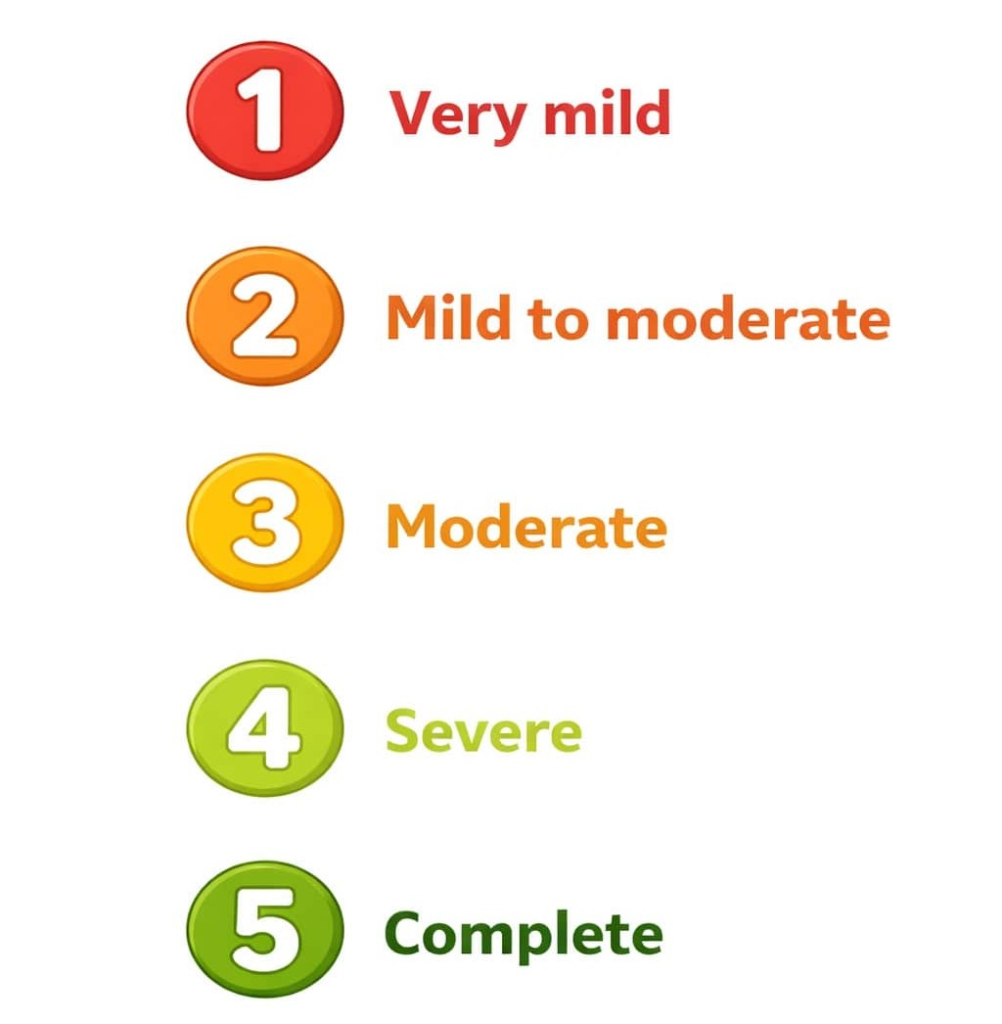
Grade 1 – Very mild
At this stage, the foreskin can fully retract when flaccid and almost fully retract when erect, but there is noticeable tightness. There may be mild discomfort, especially during erections, but hygiene is usually manageable. Many men at this grade don’t realise they have phimosis until they experience sexual discomfort or tightness during intercourse. Conservative treatments like stretching are often very effective here.
Grade 2 – Mild to moderate
With grade 2 phimosis, the foreskin can usually retract when flaccid, though it feels tight and may be uncomfortable or slightly painful. When erect, retraction is difficult or impossible. Cleaning under the foreskin may still be possible, but it often feels awkward or incomplete. Sexual activity can become uncomfortable, and tearing or irritation may occur. This is where many men begin actively seeking solutions.
Grade 3 – Moderate
At this stage, foreskin retraction is limited even when flaccid. The head of the penis may only be partially visible, or not at all. Hygiene becomes more difficult, increasing the risk of irritation or infection. Erections can feel tight or painful, and sex is often problematic. Grade 3 phimosis usually requires more consistent treatment and doesn’t tend to resolve on its own.
Grade 4 – Severe
With grade 4 phimosis, the foreskin cannot be retracted at all, even when flaccid. The opening of the foreskin is very tight, and the glans remains completely covered. Cleaning underneath the foreskin is usually not possible, which can lead to ongoing hygiene issues and inflammation. Erections may feel uncomfortable or restricted, and ballooning of the foreskin during urination can occur. Medical intervention is often required at this stage.
Grade 5 – Complete
This is the most severe form. The foreskin opening is extremely tight, and there is no ability to retract it whatsoever. Urination may be affected, infections are more likely, and pain or cracking of the foreskin can occur. Curing methods like stretching can still work at this stage, they will take longer than someone on a lesser grade, but they can absolutely still be successful!
Understanding your grade helps set realistic expectations. Milder grades are often easier to treat, while more severe grades usually need more structured or medical approaches. That said, grading is only one part of the picture — symptoms, discomfort, and quality of life are just as important when deciding how to move forward.
Causes that can influence severity
Phimosis doesn’t always stay the same. In some cases, it becomes tighter or more uncomfortable over time due to a number of contributing factors.
Poor hygiene is one of the most common issues. When the foreskin is already tight, cleaning underneath it can be difficult. This can lead to a build-up of smegma, irritation, and inflammation, all of which can reduce skin elasticity and make retraction even harder.
Recurrent inflammation, such as balanitis, can also play a major role. Repeated episodes of redness, swelling, or infection can cause the foreskin to thicken or scar slightly as it heals, gradually narrowing the opening.
Another factor is forceful retraction. Trying to pull the foreskin back too aggressively can cause micro-tears in the skin. As these tears heal, scar tissue may form, making the foreskin tighter than before and accelerating progression.
Certain skin conditions that affect elasticity or healing can also contribute, particularly those that lead to scarring or chronic inflammation.
Finally, conditions like diabetes can increase the risk of infections and slow healing, which may indirectly worsen phimosis if not well managed.
Understanding these factors helps explain why early, gentle treatment is usually better than leaving the condition to progress on its own.
Treatment options by severity
The best way to treat phimosis depends largely on how severe it is and what symptoms it’s causing. Milder grades often respond well to conservative approaches, such as gentle foreskin stretching and the use of prescribed topical creams designed to improve skin elasticity. These methods are usually done over time and can be very effective when used correctly.
As phimosis becomes more restrictive, medical treatments may be recommended. This can include stronger topical medications or closer supervision by a healthcare professional to prevent further tightening or complications.
In more severe cases, where the foreskin cannot retract at all or symptoms significantly affect daily life, surgical options may be discussed. These range from minor procedures that widen the foreskin opening to full circumcision, depending on individual circumstances.
There is no single “best” treatment for everyone. The right approach depends on your type of phimosis, your symptoms, and how the condition affects your quality of life.
Final thoughts: Your type of phimosis
Phimosis isn’t a one-size-fits-all condition. It exists on a spectrum, ranging from very mild tightness to more severe forms that can interfere with hygiene, comfort, and sex. Knowing your type of phimosis and understanding where you fall on that spectrum is important, because it takes a lot of the uncertainty and anxiety out of the situation.
The good news is that many cases of phimosis are manageable or treatable, especially when they’re approached early and correctly. Whether that means conservative methods, medical treatment, or something more involved, there are options available — and they’re not as drastic as many people fear.
By learning about the different grades of phimosis, you’re in a much better position to make informed decisions about your own body and health. If you’re unsure about your symptoms or how severe your phimosis might be, seeking professional medical advice is always a sensible step.
If you’d like to explore this further, check out the related articles on this site, where I go into treatment methods and personal experiences in more detail.