
Phimosis is one of those topics many men silently worry about but rarely speak openly about. For some, it’s a mild inconvenience; for others, it can cause anxiety, discomfort, hygiene challenges, and even pain. If you’ve found yourself searching late at night for answers on how to loosen a tight foreskin, you’re not alone.
Many men, including me, look into stretching as the first line of management—and yes, in many cases, it can be helpful. But as with anything involving delicate anatomy, technique, patience, and safety matter far more than force or speed.
This article tackles one of the biggest questions men ask: How do you stretch safely to help treat phimosis without making things worse? Let’s dive into the facts, the myths, and the right approach to take.
What Exactly is Phimosis?
Phimosis refers to a foreskin that cannot fully retract over the glans (head of the penis). In childhood, this is completely normal—over 80% of boys have a naturally non-retractable foreskin, which typically becomes retractable by adolescence.
However, when phimosis persists into adulthood or becomes painful, infected, or functionally restrictive, many men seek solutions.
There are two main types:
1. Physiological Phimosis
- The foreskin is naturally tight.
- No scarring present.
- More responsive to stretching and creams.
- Normal in boys aged 10 and under
2. Pathological Phimosis
- Tightness due to scarring or inflammation.
- Often associated with recurring infections, trauma, or a condition called Balanitis Xerotica Obliterans (BXO).
- May not respond well to stretching and might require medical intervention.
Understanding which category you fall into matters, because it determines how effective stretching might be—and whether you should be seeing a specialist first.
Why Stretching is Often Recommended
Doctors often recommend gentle stretching as a first treatment step for men with mild to moderate phimosis. Unlike surgical approaches, stretching focuses on gradual expansion of the foreskin opening by encouraging controlled flexibility.
The foreskin, like any skin, can adapt slowly over time. With consistent, gentle tension, the ring of tight tissue at the opening can become more elastic. However, this process can take weeks, and sometimes months.
The key takeaway: Phimosis is not solved overnight. Rushing the process is exactly how many men end up worsening the condition rather than improving it.
The Right Way to Stretch: What Safe Means
If stretching is going to be part of your approach, it must be done gently—and “gentle” needs to mean exactly that.
1. Never Stretch to the Point of Pain
A stretching session should involve mild tension—not sharp discomfort. Pain is not a sign that you are “making progress.” It’s a signal that tissue damage is occurring, and tissue damage leads to scarring.
Scarring = tighter foreskin, not looser.
2. Slow Wins
The foreskin should gradually become more flexible over time rather than in one dramatic breakthrough moment. Trying to rush the process can cause:
- microtears
- infections
- bleeding
- scar contraction (which tightens the foreskin further)
Consistency matters more than force. Think small improvements over time.
The amount of stretching sessions and the duration of these is very important.
- 1 to 2 sessions a day
- 10 minutes a session
This frequency and duration is absolutely fine. Anything more than this and you are running the risk of unnecessary injury.
3. Pairing Stretching with Medical Creams
When you ask about how to stretch your foreskin, many urologists will prescribe you topical corticosteroid creams, such as betamethasone, hydrocortisone, or mometasone. These creams reduce inflammation and increase elasticity when used correctly.
Steroid creams should only be used under medical supervision. They are safe when prescribed, but using them incorrectly or without diagnosis risks thinning the skin or missing an underlying cause.
The Wrong Way to Stretch: What to Avoid Completely
Men who feel desperate sometimes make desperate decisions. However, certain methods circulating online are not just ineffective—they’re dangerous.
❌ Do Not Force Retraction
If you have to grit your teeth, hold your breath, and pull harder, you are injuring the tissue.
❌ Do Not Use Household Objects or DIY “Gap Wideners”
Anything inserted into the foreskin to widen it—bottle caps, pens, improvised rings, random objects—poses serious risks. These include:
- tearing
- infection
- paraphimosis (when the foreskin gets stuck behind the glans—this is a medical emergency)
❌ Avoid Harsh Tearing Methods Disguised as “Fast Fixes”
Some advice forums claim that once you tear through the tight ring, you’ll be “free.” What actually happens is:
- uncontrolled tearing
- pain
- scar tissue formation
- tighter foreskin than before
The foreskin is not something to rip open. It is living tissue, richly supplied with nerves, blood vessels, and sensitive structures.
How Long Does It Take for Stretching to Work?
Men often expect progress within days, but stretching for phimosis rarely works on that timeline. Most see slow, steady improvements if done daily or near-daily.
Typical timeframe: 4 to 12 weeks
In some cases: several months
Not everyone responds the same way. Some men have naturally more elastic tissue, while others have a dense, fibrous ring that responds more slowly.
How Can You Make the Process Easier?
10 years ago, I thought I had to choose between stretching and surgery. I basically just searched “how to stretch your foreskin” online, tried a few times in the shower… failed… and then went to get a circumcision. I was completely unaware of all of these different products and methods that could have cured my phimosis whilst saving my all-important foreskin. One of the main ones I wish I knew about (if it was even available back then) is Novoglan.
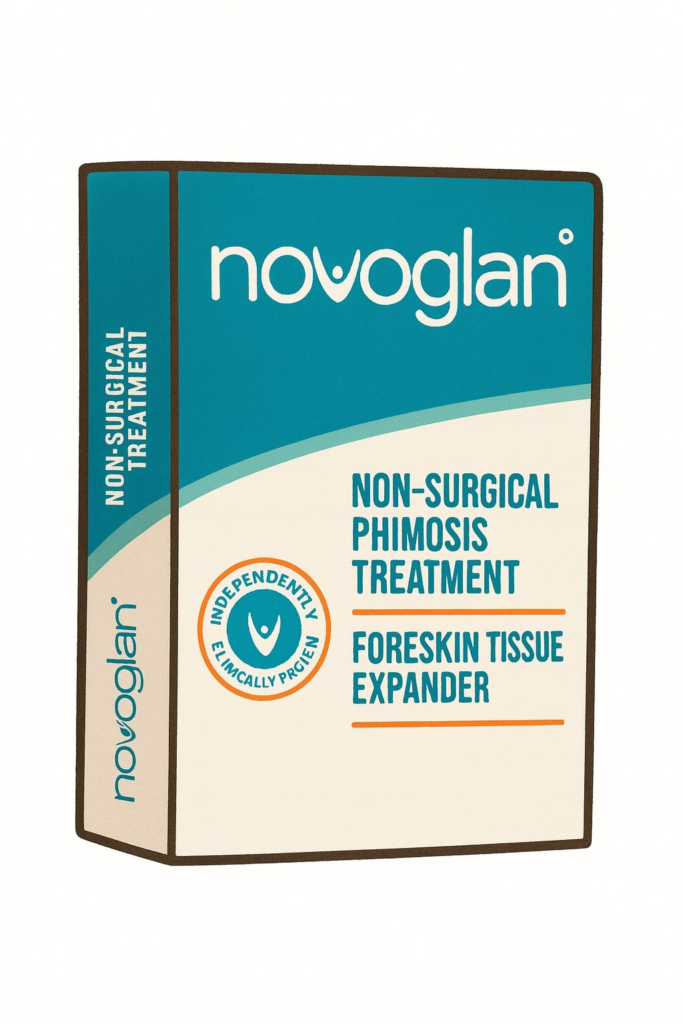
Novoglan is a non-surgical, at-home treatment kit designed to help men with adult phimosis gently and gradually stretch a tight foreskin. Rather than relying solely on manual stretching (or immediately resorting to surgery), Novoglan uses a small, medical-grade silicone balloon inserted beneath the foreskin.
Once in place, the balloon is inflated with gentle, controlled pressure — typically for short sessions each day. This gentle tension encourages the foreskin skin tissue to expand over time through a process called tissue expansion: repeated, mild stretching stimulates the skin to grow new cells and gradually widen the foreskin opening.
Because this method is relatively controlled, it can feel safer and more manageable than aggressive manual stretching or forced retraction. According to a recent clinical trial, around 90% of adult men using Novoglan achieved improved foreskin retraction — with many reaching full retraction after a period of 4–8 weeks of regular use.
Many users also report reduced discomfort, less anxiety about their condition, and an improved sense of normalcy — making Novoglan not just a physical aid, but potentially a psychological relief too.
You can read more about their product here.
When Stretching Isn’t the Answer
Stretching won’t fix every case of phimosis. For some men, especially those with scarring or BXO, a different approach is required.
Signs you should see a doctor rather than continue stretching:
- A white, scar-like ring at the foreskin opening
- Cracking or splitting when retracting
- Recurrent infections or inflammation (balanitis)
- Difficulty urinating due to tightness
- Painful erections because the foreskin won’t move
- Sudden swelling after retraction that won’t go back down (possible paraphimosis)
These scenarios suggest a condition beyond simple tightness and require evaluation by a urologist.
Alternatives if Stretching Fails
Not every man wants surgery, and today there are more options than ever.
1. Prescription Steroid Cream + Gentle Stretching
Often successful and least invasive.
2. Preputioplasty
A minor surgical procedure that widens the foreskin without removing it.
3. Frenuloplasty
If the tightness is caused by the frenulum (the band of tissue underneath the glans), this procedure releases it.
4. Circumcision
While effective, it’s typically reserved for those who:
- don’t respond to stretching or creams
- have significant scarring
- have medical conditions where removal is necessary
Modern urology rarely jumps to circumcision as the first answer.
A Word of Warning on Circumcision
Whilst I do not regret getting a circumcision, I really wish I was told about the downsides before going ahead with it.
The biggest problem with circumcision is the sensitivity that is lost over time due to your head being over-exposed. After 10 years of having no foreskin I can say with confidence that this isn’t a myth, you really do lose a lot of the feeling down there and I would highly recommend exhausting all options first before going under the knife.
The extra work you have to put in to save your foreskin is well worth it.
Final Thoughts: How to Stretch Your Foreskin Safely
Stretching can be a helpful method for managing phimosis, but only when done correctly and calmly. The foreskin isn’t a muscle to be forced into obedience—it’s a delicate, sensitive part of your anatomy.
If you choose to stretch:
- stay gentle,
- avoid pain,
- and know when it’s time to consult a professional.
For many men, progress happens gradually, not dramatically. Respecting that process is key to improving foreskin mobility without injury, scarring, or setbacks.
Phimosis doesn’t have to define your relationship with your body. With proper care, accurate information, and patience, most men find a path forward—whether through stretching, medical assistance, or alternative treatment.